Thursday, September 14, 2017

QSL: 6RN ABC Radio National, Wagin WA, 1296

We erected our new, 80-degrees beverage last weekend aiming to hear more from central and western Australia. And we did! On September 9, during a lull in the solar storm, we had a couple of hours with good signals, including this one which is new for me.

Email QSL yesterday. Only my second confirmed West Australia station, but I expect the number to rise during the season.

Sunday, September 10, 2017

KONG34 DX-pedition - In Preparation For The Coming Season (Pt. 4)

Yet another sunny, but at times quite windy day in Kongsfjord. Temperatures maxed out at 9 Celsius. Tomorrow is departure day for OJ Sagdahl, TJ Bråtveit and Ole Forr. And for me too, but not quite as early.

Today was used for checking recordings from the day before, when conditions to central and western parts of Australia and India, were good. We also did some antenna maintenance, but most of the time we just chilled out and had a few beers.

Today's dinner was a roast leg of lamb, with potato/carrot paste, sauce with onions & garlic, and fried broccoli. OJ picked a superb wine to go with a superb lamb, the 2013 Fontodi Chianti Classico.

We had some hopes for this evening's DX, but at 17:00 an X flare wiped out the Mediumwave, so no new loggings for us today.

The weather forecast says rainy and windy on Monday, so this picture from tonight at around 9 pm is possibly the last clear-sky picture from this DX-pediton.


The KONG DX Site - Our Gear

With four blokes wanting to use four antennas, there's a bit of logistics to take care of. Here's how the living room in Kongsfjord looks like during the DX season.

First, we have my PCs and SDRs, on the shelf at the back. One Dell Optiplex, Micro Form Factor, and two Intel NUCs control my three Perseus. Each have an 8 TB hard drive. The Diamond 30A power supply powers the hard drives and one of the NUCs. My KiwiSDR is powered by a lab-grade 5VDC PSU, which also feeds two Perseus (a NUC powers the last one). A web-based antenna switch is on the right, because I use four antennas but only have three SDRs.

On the table in front are four DX-Engineering preamps for the beverage feedlines coming through the wall. They are fed by a separate, 13.8VDC PSU (under the bed). From each preamp goes a coax to four splitters. The three to the left will be replaced by Mini-Circuits 8-port splitters like the one on the right.


The KiwiSDR is connected to an 80-metre longwire in N-S orientation. The feedline is amplified with a Wellbrook splitter/preamp. The Cloud-IQ on the table is also connected to the longwire. Other SDRs in my shack is the ColibriNANO and the Airspy R2/Spyverter R2.

Moving to the other end of the living room are Ole Forr's and OJ Sagdahl's gear; five Perseus in all, plus preamps and a number of 8 TB hard drives, also two web based antenna switches. The PCs are hidden from view. The Tandberg Huldra 11 receiver now serves as a front end for my DAB+ receiver on the shelf above, partly hidden.


Finally a peak at TJ Bråtveit's setup, Perseus, Winradio G33DDC and Elad FDM-S2, two PCs and 8 TB hard drives, and a web-based antenna switch.


Linear power supplies is a must, and we have four of these 30A beasts, plus a few small ones. The voltage knob is removed for equipment safety reasons.


There are two mobile broadband networks. The main network is a 4G Telia network with a 200 GB/mo cap. We have remote control of our equipment through this network, using Teamviewer or LogMeIn Pro. The other network is a Telenor 3G (soon to be 4G) network with a 40 GB/mo cap. This is the KiwiSDR network. We have line-of-sight to the transmitters 3 km away so the speed is very good. All internal connections are cabled.

Saturday, September 09, 2017

KONG 34 DX-Pedition - In Preparation For The Coming Season (Pt. 3)

Another sunny, but a bit windy day in Kongsfjord, with temperatures reaching 10 Celsius. Time to put up our new 560 meter beverage at 80 degrees. This should enable better reception of central and western parts of Australia. This antenna has a 285 meter coax feedline. The antenna and feedline are roughly described below.


Hundreds of goosanders were having a party in the bay just outside my house today. Maybe they were discussing the flight plan for the migration.

'

Today's dinner was reindeer stew with a paste made of potatoes, carrots and celeriac, and lingonberry jam from berries picked underneath the 310 beverage a couple of hours earlier. The wine was an excellent Cotes du Rhone.

And imagine our surprise when South Australia was noted with excellent signals duriing the meal! The new 80 degrees beverage delivered on its first day, despite the terrible conditions. Great signals on 729 and 891.

Friday, September 08, 2017

KONG 34 DX-Pedition - In Preparation For The Coming Season (Pt. 2)

Today was noise hunting day. One possible source for our intermittent noise was the wind power facility at Raccucærro. The site manager invited us in to do measurements with a Cloud-IQ and a Wellbrook 1530LF loop. Preliminary results are that the windpark is not responsible for the noise, however when we were out the noise disappeared, so we're still a bit inconclusive. Great site though.

Other things we did was to finish the 340 beverage and prepare for the roll-out of the 80 beverage.

For dinner we had premade fish gratin, consisting of first class cod, carrots, ginger, leek, celeriac and spices. Assorted cheese for dessert.

Today's picture is of course from the wind park, at 400+ masl. No vegetation at all, and lots of wind.

KONG 34 DX-Pedition - In Preparation For The Coming Season (Pt. 1)

As usual in early September, the KONG crew meet for an oval weekend to set up the gear for the coming winter. This includes to finish and secure the three usual beverages (50, 310 and 340 degrees), plus setting up another beverage at 80 degrees.

We're also on a noise finding mission, so equipped with a Wellbrook ALA-1530LF loop we will use the weekend to track down the noise source, or sources, which have pestered our low signal level MW reception.

With solar conditions like today we're not expecting to hear anything. We do have a nice selection of beers to test though, so we'll manage. We did get hold of what seemed to be the last stock in Norway of Death from Above (Garage Project), and got a nice taste of Tohki-Shu from Toccalmatto/Nøgne Ø

Thursday's dinner was fresh salmon loins from Lofoten, fried on one side then put in the oven to rest a bit, and carbonara. Chocolate pudding & custard for dessert. Nicely accompanied by a 2014 Donna Margherita. It was a left-over from last October.

Amazingly, almost no aurora has been visible so far. The picture was taken at 3:30 local, 75 minutes before sunrise. The twilights are long in the Arctic. The noise hunting mission starts at 7:30. More as it happens.

Thursday, August 17, 2017

QSL: WEZS Laconia NH 1350

WEZS was heard in September last year just before they switched to night power. From a reminder yesterday came a long and friendly response from the General Manager.

Sunday, August 13, 2017

A Quick Look At The Elad FDM-S2

Seasoned FM DX-er Ole Forr lent me one of his FDM-S2s a few days ago, and I have shared some very brief impressions here. The short version: Good radio. Original software is not to my liking, but SDR Console V3 and HDSDR work well.

Saturday, August 12, 2017

Revised ColibriNANO Review - Doesn't Team Up With Teamviewer

I had to add a paragraph to my ColibriNANO review. The case is that when the Nano loads, in ExpertSDR or in HDSDR, Teamviewer CPU load goes all the way up 60-70 %, from its normal 5-15 %. Add the SDR program CPU load, and the processor is banging its head against the roof.

This is an important consideration if you plan to run the ColibriNANO with Teamviewer.

Friday, August 11, 2017

The MS-S7-Web Remote Antenna Switch

You can either have one radio for each antenna, or use an antenna switch. Antenna switches are found in any HAM store, but if you run remote, you need to be able to switch antennas remote as well.

Enter the MS-S7-Web Remote Antenna Switch. I first heard about it when it was introduced as an extension to the KiwiSDR. I had no plans to use it with my KiwiSDR, but the KONG crew has plans of erecting another beverage antenna in Kongsfjord, and I didn't really want to add another SDR + PC to the shack.

I bought the MS-S7 from Bulgaria in the beginning of June, but haven't had the opportunity to test it until now. If memory serves me right, I paid around EUR 170.

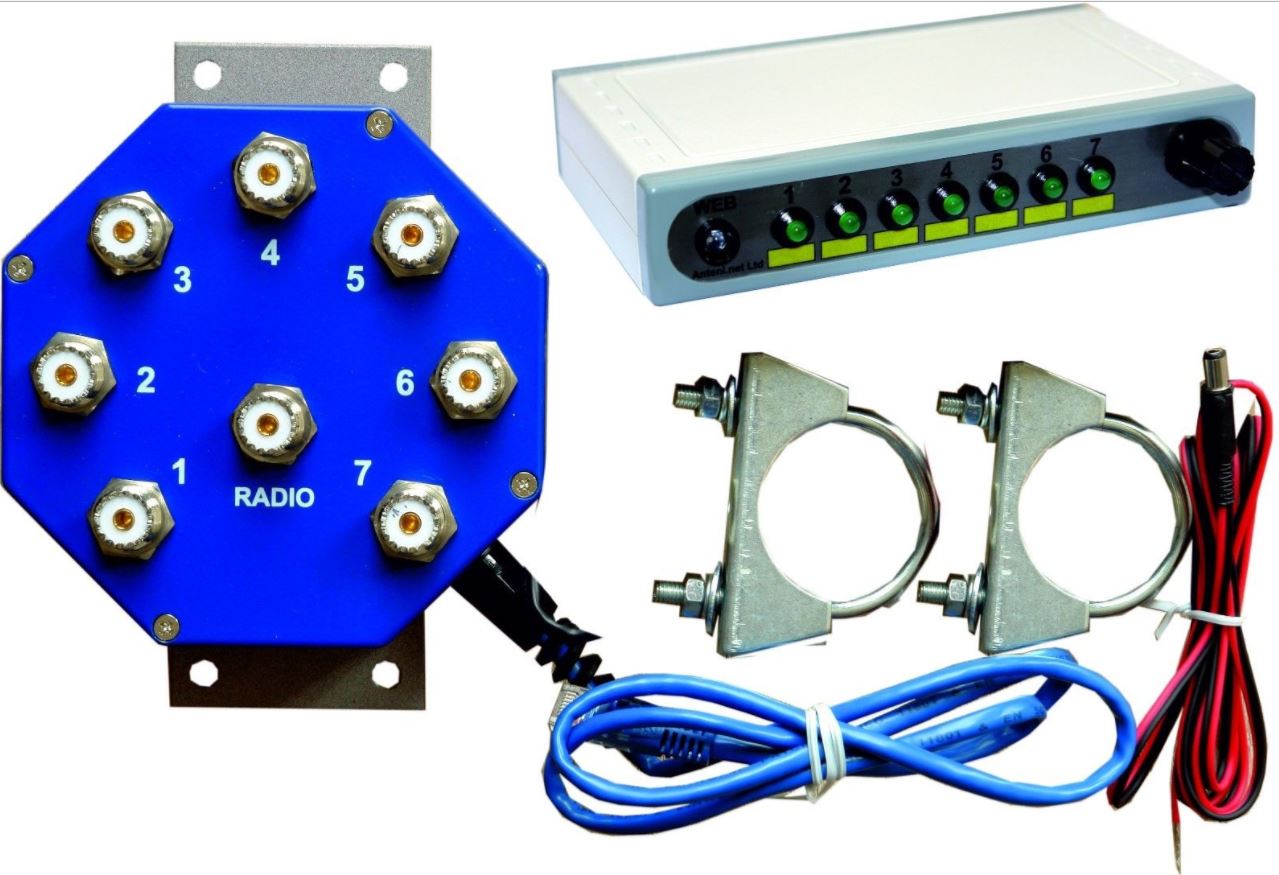
The package consists of an in-house antenna selector, which can be controlled via web, or manually. It is connected to an outdoor (which can of course be used indoor) antenna switching box with seven antenna connector in additon to one connector for the receiver. The antenna selector connects to your router or switch (or PC I presume, not tested), and it needs 12 VDC.
From the eBay ad

The antenna selector has green LEDs for each antenna. Also there's a blue power indicator LED. The green LEDs are quite dim and easy on the eyes. The blue LED is anything but! I feel tempted to replace this one, if not I do need to cover it somehow.

The device works via an Internet browser (Firefox and Chrome are recommended). It can be set up with a static IP (which is better than DHCP in this case), and the Device Settings will look similar to that below.

There are two tabs in the user interface, and the other is the contol panel, on which you're supposed to click on the "ON" labels to change antenna. You will hear two clicks, one to disconnect from one antenna, and one to connect to the other. Or so it's supposed to work.
Web based control panel

Web based config panel


But I often need to click an extra time to get the second relay to connect. This may make problems if you are running a script-based automated antenna switching schedule. If you do, it may be wise to program double-click instead of single-click. I've always managed to change antenna when I double-click.

So what about signal leakage from one antenna connector to the other? The short answer is: There isn't any. I was rather taken aback by this. I connected a signal generator to one port, and a longwire antenna to the other. I set the signal generator up to maximum (99 dBu which equals -6 dBm), and there wasn't a trace of a carrier on the frequency I had chosen to monitor on the longwire antenna port. So was the case with the other connectors - although I admit I didn't put a 50 ohm load on them.

I also checked for insertion loss. It must be close to zero, because I wasn't able to detect any difference.

I did however notice that the switch makes its own noise, despite being fed from a linear power supply. It raises the noise floor of our super-quiet 500 meter beverage from around -135 dBm to more than -130 dBm. It also produces spikes every 8 kHz at levels around -120 dBm to -110 dBm. Admittedly, most DX-ers won't notice this, and only we will notice on certain parts of the day. But those certain parts happen to coincide with super-weak signals from the Pacific coming in. So this is not good.
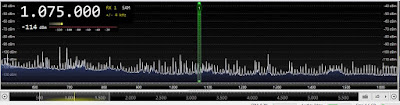
Via antenna selector

Bypassing antenna selector


So, apart from the gruelling blue lazer-like LED and the somewhat unpredictable antenna selector procedure, this is indeed a good product for many DX-ers.